
Case Study: Building a High-Performance Automated Regulatory Oversight System with Oracle APEX 24.2
From Real-Time Auditing to AI-Powered Insights: How Architecture Meets Regulatory Demand
Lee este APEX Insight en Español.
The High Stakes of Regulatory Technology
In the enterprise world, "Compliance" is often synonymous with "Complexity." When regulatory requirements shift, systems must adapt—not in months, but in days. Building a platform that handles thousands of concurrent audit requests while maintaining an immutable trail of truth is no small feat.
Architecting an Automated Regulatory Oversight System requires more than just data entry. Avoiding the pitfalls of low-code "spreadsheets-as-apps," Oracle APEX 24.2 provides a robust framework to create high-performance, secure, and AI-enabled solutions.
This APEX Insights entry breaks down the architectural patterns that allow such systems to scale from a prototype to a mission-critical enterprise asset.
The Challenge: Concurrency vs. Consistency
A regulatory oversight platform faces a unique dual-pressure:
The Read Load: Auditors running complex, cross-schema reports on years of historical data.
The Write Load: Real-time validation and logging of thousands of user actions across different time zones.
The objective is to maintain sub-second response times for the UI while ensuring that not a single audit record is lost.
The Architecture: Powering through APEX 24.2
1. AI-Powered Auditor Assistance
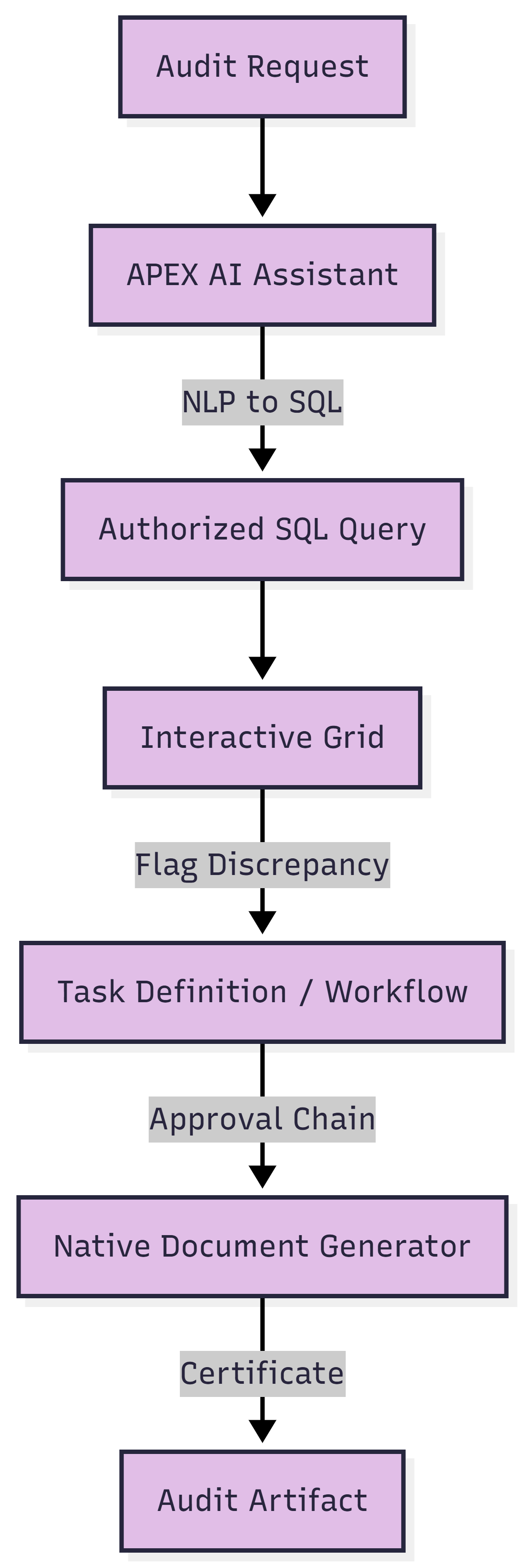
A key architectural pattern for compliance systems is the integration of an APEX AI Assistant. Instead of forcing non-technical auditors to learn complex filtering logic, native AI capabilities in version 24.2 can be utilized to simplify data discovery.
Auditors can ask: "Show me all high-risk discrepancies within the current fiscal period," and the system generates the appropriate SQL query on the fly, rendering the results in a hardened Interactive Grid.
Architect's Note: The specialized AI-based Natural Language to SQL feature ensures that users only query views they are authorized to see.
The Oversight Workflow (Architecture)
To visualize how these components interact at scale, we use a decentralized but database-centric workflow:
2. Rigorous Approval Workflows
Compliance requires a chain of command. Using the improved APEX Workflow Engine (Task Definitions), multi-level approval processes can be modeled directly in the database.
Outcome: 100% visibility into "Who approved what, and when."
Performance: Workflows run as native database background processes, meaning the UI never waits for the "next step" to compute.
3. Native Document Generation
Compliance is nothing without certificates. For the generation of PDF audit summaries, migrating from external solutions to the APEX Native Document Generator simplifies the technical stack.
Keeping document generation within the database tier reduces network latency and simplifies the security posture, as sensitive compliance data never leaves the Oracle environment until rendered.
Expanding on the discussion of caching strategies, a multi-tier strategy is essential for platform stability:
PL/SQL Result Cache: Ideal for global compliance rules and risk-level mappings. Since these tables are often "Read-Mostly," CPU overhead can be reduced by up to 40% globally.
Scalar Subquery Caching: In heavy "Compliance Summary" views, scalar subquery caching helps avoid expensive context switches when calculating risk percentages per row.
Region Caching: Cached by User logic applied to the main auditor dashboard provides instant page loads for the most frequent daily views.
Security & Governance: SOC2 by Design
APEX 24.2 provides a "Secure by Default" foundation, but enterprise platforms require a deeper security posture:
Parameterized Everything: Ensuring 100% protection against SQL injection.
Context-Aware Authorization: Using session-based contexts to ensure that an auditor's region is automatically applied as a filter to every query via VPD (Virtual Private Database).
APEX_ESCAPE: Rigorous output escaping to prevent XSS in custom report templates.
Building a modern oversight platform isn't just about checkboxes; it's about trust. By leveraging the modern features of Oracle APEX 24.2, architectural excellence is realized:
🟢 Improved Report Generation speed compared to non-optimized, monolithic architectures.
🟢 Operational Continuity during regulatory updates due to the modular PL/SQL architecture.
🟢 Enhanced Auditor UX through AI-assisted discovery.
Effective architecture is the bridge between regulatory demands and technical reality.
🎁 Download the "Oversight System Architecture Checklist (PDF)" to audit your own enterprise compliance apps.
Is your compliance architecture meeting the mark? Let's discuss the challenges of scaling enterprise APEX apps in the comments.
🚀 Take the Next Step
Review our previous entry on Caching Strategies.
Explore APEX 24.2: Check the official release notes for more on AI and Workflow.
Connect with the community: Join the conversation on LinkedIn.
☕ Schedule a Call
💼 Connect on LinkedIn
🐦 Follow on X


